UK
UK Ireland
 Scotland
 London

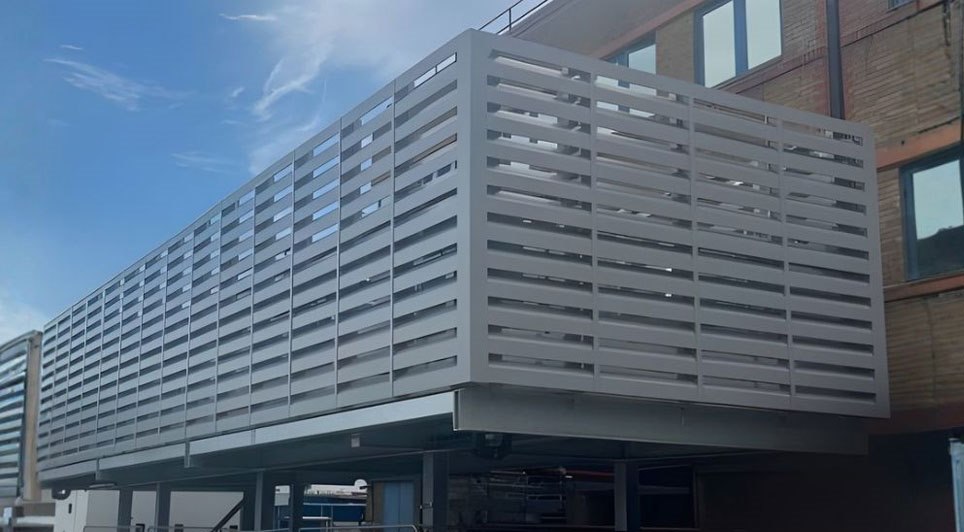
In modern construction and industrial design, a delicate balancing act takes place behind the scenes.
Buildings must maintain effective airflow through ventilation systems, while simultaneously controlling the noise generated.
High-powered HVAC units, generators and extraction systems don’t just move air. They also transmit sound, sometimes at levels that can disrupt operations, affect people’s wellbeing and breach regulatory limits. To assure buildings meet both environmental and performance standards, acoustic louvres are a vital part of the design process.
How do they work?
Components installed at air intake or discharge points within a building’s ventilation system; the primary purpose of acoustic louvres is to attenuate sound without significantly impeding airflow. They incorporate sound absorbing materials and have specific designs to disrupt and dissipate airborne sound waves. The shape, arrangement and configuration of the louvre blades and internal components influence how both air and sound move through the system.
Typically constructed from galvanised steel or aluminium, these systems include perforated facings and acoustic infill materials, such as mineral wool. As air passes through, sound energy is absorbed and partially converted into low-grade heat through friction within the material fibres. At the same time, the angled blade design helps deflect and scatter sound waves, reducing their direct transmission.
The result is a component that enables ventilation systems to function efficiently while significantly lowering noise emissions, which is a crucial requirement in both industrial and commercial environments.
Why noise control is critical
Noise control has become increasingly important in buildings, particularly in the UK, where urban density continues to rise. According to the World Health Organisation, prolonged exposure to environmental noise can lead to serious health impacts including hearing loss, sleep disturbance, cardiovascular issues and reduced cognitive performance. In workplaces, excessive noise has been linked to reduced productivity and increased fatigue.
From a regulatory perspective, UK planning authorities and environmental health regulations impose strict limits on permissible noise levels, particularly in mixed use developments or sites near residential areas. Standards such as BS 4142 assess industrial and commercial sound and influence how building services are designed and implemented.

Ventilation systems are often a primary source of environmental noise. Fans, ductwork, and mechanical plants can generate sound levels ranging from 65 to 85 decibels at close proximity, sometimes higher in large facilities. Without proper mitigation, this noise can escape through openings and impact surrounding areas.
Key factors influencing effectiveness
The performance of acoustic louvres depends on several interrelated factors including material composition, blade geometry and installation placement.
Material selection is fundamental; high-density acoustic infill improves sound absorption, particularly at mid to high frequencies. Meanwhile, perforated metal facings allow sound waves to enter the louvre structure without obstructing airflow. The thickness and density of these materials directly influence the level of noise reduction achieved.
Design geometry also plays a critical role. Blade depth, spacing and angle determine how sound waves interact with the louvre. Deeper blades generally provide higher attenuation but may restrict airflow if not carefully designed. This introduces the concept of insertion loss – a key performance metric that measures how much the noise is reduced as it passes through the louvre.
Poorly positioned louvres may fail to intercept noise effectively, while undersized units can increase air resistance and strain ventilation systems. Engineers often rely on Computational Fluid Dynamics modelling to optimise both airflow and acoustic performance, ensuring the system meets operational and regulatory requirements.
Advantages of acoustic louvres
One of the most immediate benefits is improved comfort. By reducing noise levels, they help create more comfortable and healthier indoor and outdoor environments. This is particularly valuable in workplaces where excessive noise can affect concentration, communication, and overall wellbeing.
From a financial perspective, acoustic louvres offer a cost-effective approach to noise control. Addressing sound at the point of entry or exit reduces the need for more extensive internal soundproofing measures. Retrofitting louvres into existing systems is also relatively straightforward, making them a practical solution for older buildings.
Installation can help ensure that projects meet planning conditions and environmental noise limits, reducing the risk of fines or operational restrictions. They also support adherence to occupational health standards, such as those outlined by the Health and Safety Executive.
In terms of measurable performance, they can achieve noise reductions of between 15 and 30 decibels, depending on their configuration. This level of attenuation can make a substantial difference in both industrial and urban contexts.
Creating compliant building projects
Successful integration of acoustic louvres begins at the design stage. While they can be retrofitted, incorporating them early in a project allows for better coordination with architectural and mechanical systems. This ensures that both airflow and acoustic requirements are met without compromise.
Customisation is often necessary, as no two projects share identical conditions. Factors such as airflow rates, noise frequency, available space and environmental exposure all influence the final specification. Louvre systems can be manufactured in a range of depths and configurations to suit these varying demands.
Structural considerations, including wind loading and support frameworks, need to be addressed to ensure long-term performance. In external applications, weather resistance is a key factor, with designs often incorporating rain defence features to prevent water ingress.
Collaboration between acoustic consultants, engineers and construction teams is essential throughout the process. Their combined expertise ensures the selected solution delivers the required balance between ventilation efficiency and noise control. Detailed performance data and modelling tools further support informed decision making.
Applications across modern building design
In industrial facilities, they are commonly installed in generator rooms, boiler houses and manufacturing plants, where high levels of mechanical noise are generated. In commercial developments, they are often used in HVAC plant rooms and rooftop installations, particularly where buildings are located near residential areas. Data centres and energy infrastructure also rely heavily on acoustic louvres. These environments require continuous cooling, often resulting in significant noise output.
The growing emphasis on sustainable, occupant focused design has brought noise control into sharper focus. As buildings become more complex and urban environments more demanding, the need for effective acoustic solutions continues to increase. Ultimately, integrating acoustic louvres is about creating environments that support health, productivity, and long-term usability, while remaining compliant to evolving regulations.