UK
UK Ireland
 Scotland
 London

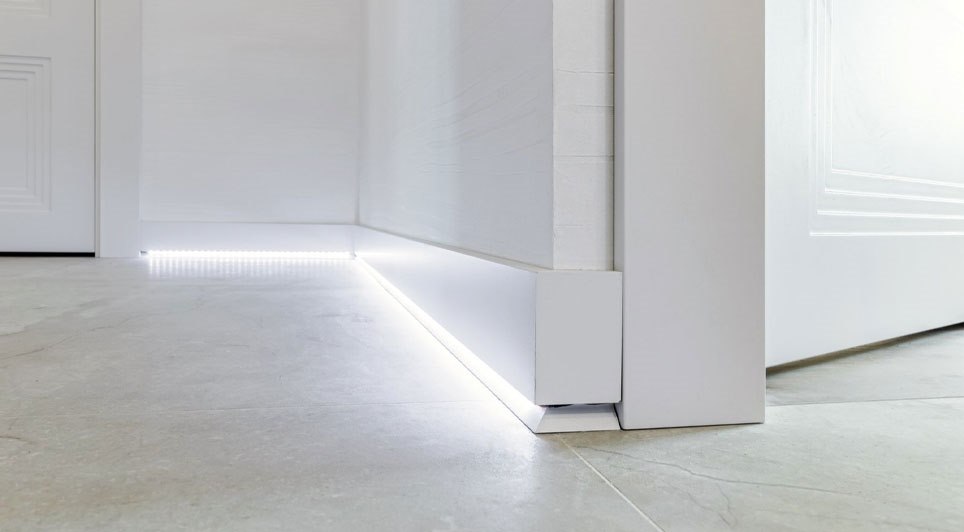
LED skirting boards combine traditional skirting with integrated lighting to create a continuous glow along your floor perimeter. Whether you're considering purpose-built LED skirting or adding lights to standard boards, understanding the technical aspects and practical implications helps you make an informed choice.
What we'll cover
• How LED skirting works
• SMD vs COB: Which strip to choose
• Installation components and planning
• Power consumption and costs
• Living with LED skirting
• Ready-made grooved skirting
How LED skirting works
LED skirting systems consist of three main components: the LED strip itself, a driver (transformer) that converts mains electricity to low voltage, and the skirting board or profile that houses the lighting.
The LED strips operate on 12V or 24V DC power - much safer than mains voltage and perfect for DIY installation. They come in various densities, typically 30, 60, or 120 LEDs per metre. More LEDs mean brighter, more uniform illumination, though also higher power consumption.
The secret to professional-looking LED skirting? Keep the light source hidden. When installed correctly, you shouldn't see the individual LEDs - instead, the light washes onto the floor or wall, creating an indirect lighting effect that won't leave you with spots in your eyes.
Most LED skirting installations use one of three approaches:
• Purpose-built LED skirting profiles with integrated channels
• Standard skirting boards modified with a routed groove
• Separate LED channels mounted behind or on top of existing skirting
"Low-level perimeter lighting can create what I think of as a form of spatial reassurance," Theresia Alamsyah, Interior & Lighting Designer, Certified Lighting Consultant, DIALux Evo, said. "At night, the body often needs just enough light to understand the thresholds and direction of movement. When concealed carefully, light can softly define this information without overwhelming the eye. The key is restraint: skirting LEDs should be treated as indirect architectural lighting rather than exposed decorative strip lighting.
"This is where the difference between a refined installation and a disruptive one often appears. If the light source is too bright, too cool in colour temperature or visibly dotted, it can easily feel visually abrasive. However, when specified with a warm tone, suitable diffusion (ideally with a dimmable control), skirting lighting can become a true functional asset. In domestic interiors or luxury hospitality setting, this can be especially valuable for supporting intuitive circulation for evening use. For example, moving through a hallway or kitchen during night time will become almost gentler and more instinctive. Rather than simply decorating the interior, a well-planned skirting light becomes a quiet guide by shaping the perceiver's orientation through a subtle, unobtrusive illumination."
SMD vs COB: Which strip to choose
The choice between SMD (Surface Mounted Device) and COB (Chip on Board) LED strips makes all the difference to how your skirting lighting looks and performs. Let's see what each offers.
• SMD LED strips
SMD strips feature individual LED chips mounted on a flexible circuit board. You'll see them described as 3528 (3.5mm × 2.8mm chips) or 5050 (5mm × 5mm chips). They're the traditional choice, widely available and affordable.
SMD characteristics:
- Power consumption: 4.8-20W per metre
- Light output: 330-2000 lumens per metre
- Visible as individual dots, even with diffusers
- Typical lifespan: 30,000-50,000 hours
- Cost: £5-15 per metre
COB LED strips
COB technology places multiple LED chips directly on the circuit board with a continuous phosphor coating. The result? A seamless line of light without visible individual LEDs - much like a glowing ribbon.
• COB characteristics:
- Power consumption: 8-18W per metre
- Light output: 680-1500 lumens per metre
- Continuous, uniform light with no dots
- Typical lifespan: 50,000+ hours
- Cost: £15-30 per metre
"Even with the right LED and diffuser combo to make it look continuous, if it's going on baseboards and you can see the strip directly, it's going to be a glare bomb. The emitting surface needs to stay out of direct line of sight." - Professional installer's observation

While COB strips cost more initially, their superior light quality and longer lifespan often make them the better choice for visible installations like skirting boards. The continuous light line simply looks more professional.
Installation components and planning
Successful LED skirting installation requires more than just sticking some lights to your boards. Several components need careful planning - particularly where to hide them all.
The driver dilemma
Every LED strip needs a driver (transformer) to convert mains voltage to 12V or 24V DC. These aren't small - think of a laptop power brick. Now imagine finding somewhere to hide one (or several) of these in your room.
"Any strip of quality will have a nice long thin wire between the unsightly transformer and the strip because they are designed to be hidden. Do otherwise and it's a potential train wreck." - DIY installer's experience
Common driver hiding spots include:
• Inside kitchen base units or built-in furniture
• Behind large furniture pieces (with adequate ventilation)
• In ceiling voids or dedicated electrical enclosures
• Behind a removable section of skirting
• Inside rebated skirting
Important: LED drivers generate heat and need ventilation. Never enclose them completely without airflow, as this can lead to premature failure or even safety issues.
Wiring considerations
Low-voltage wiring runs from the driver to the LED strips. Key challenges include:
• Doorways: Cable must route under floors, through walls, or use threshold strips
• Corners: LED strips require connectors or soldering at 90-degree turns
• Voltage drop: Long cable runs may result in dimmer lights at the far end
• Connection reliability: Soldered joints typically outlast push-fit connectors
"The big question is what are your thoughts on how to get power to the LEDs? You can get dual profile skirting where you could maybe machine in a slit for the LED light, then use the missing profile to run cables." - Home renovator's planning query
A customer example
This customer project shows a different route: visible LED points set into the skirting board, then continued up the architrave. The lights sit at regular intervals, roughly 20cm apart, so the effect is more like marker lighting than a continuous LED strip.
Electrical regulations
Under UK Building Regulations Part P, connecting an LED driver to your mains electricity supply may be notifiable work, particularly if:
• You're creating a new circuit from the consumer unit
• The work is in a kitchen or bathroom (special locations)
• You're altering existing circuits beyond simple like-for-like replacement
While fitting the low-voltage LED strips themselves is typically DIY-friendly, the mains connection often requires a qualified electrician to ensure compliance and safety.
Power consumption and costs
One genuine bright spot with LED skirting is the running costs. LED technology is remarkably efficient, and your electricity bill won't suffer much even with regular use.
At current UK electricity prices (approximately 25p per kWh), the annual running costs for different LED strip types are refreshingly modest:
Basic SMD – 7.2W – £26
Standard COB – 10W – £37
High-output COB – 14W – £51
The real investment comes upfront. Here's what a typical 4×4m room (14m perimeter) might cost:
LED Skirting Cost Breakdown (14m room):
LED Strips – £210-420
Channels – £280-560
Driver – £55-110
Install – £200-500
Total: £745-1,590
These figures assume quality components. You can certainly find cheaper options, but as many homeowners have discovered, bargain LED strips often lead to disappointment down the line.
Living with LED skirting
While LED skirting can create beautiful lighting effects, it's worth understanding how it performs in real homes rather than showroom settings.
See every speck of dust
Low-angle lighting from skirting boards illuminates your floor in ways overhead lighting never does. This creates lots of little shadows - suddenly, every speck of dust, pet hair, and crumb becomes dramatically visible.
"Please be aware that this will highlight every flaw in your floor surface and the slightest bit of dust or fluff anywhere near it." - Homeowner warning
It's not that LED skirting creates more dirt - it just reveals what was always there. In kitchens particularly, where cooking inevitably leads to dropped crumbs and spills, the effect can be... illuminating. If you don't have the latest Dyson with lasers and spotlights, you might find this helpful for cleaning.
• Dust casts dramatic shadows
• Pet hair becomes surprisingly visible
• Floor scratches and imperfections are highlighted
• Kitchen debris is constantly highlighted
Direct visibility concerns
"You do not want to look at these things directly, if there's a chance of them getting kicked, scuffed, vacuum bashed etc now there's a second reason not to do this. I'm getting spots on my eyes just thinking about it." - LED lighting user
The positioning is crucial - if you can see the LED strip directly when sitting or walking, you'll experience glare. Proper installation keeps the light source hidden, directing illumination onto surfaces rather than into eyes.
Where LED skirting shines (and where it doesn't)
Works brilliantly in:
• Home cinemas and media rooms
• Modern minimalist interiors
• Hallways for night-time navigation
• Bathrooms (with IP-rated strips)
• Bedrooms for ambient evening lighting
Think twice about:
• High-traffic areas with pets
• Kitchens (unless you love cleaning)
• Rooms with uneven floors
• Traditional period properties
• Areas prone to knocks and scuffs
Ready-made grooved skirting
If you like the idea of LED skirting but want to maintain a traditional look, several standard skirting profiles come pre-grooved for LED strips. These combine classic designs with modern functionality.
Summary
A well-planned LED skirting installation provides reliable low-level lighting and a contemporary finish. Select an appropriate profile with a pre-machined groove, choose the correct LED strip (COB for a continuous light line, SMD for lower initial cost), and allocate space for drivers and cable routes from the outset.
Skirting World offers a range of grooved MDF boards that simplify the process by integrating the lighting channel into the profile. Combine these with quality, UK-rated LED components and a qualified electrician for the mains connection where required.
Explore the full grooved skirting collection to find the profile that best suits your project.
FAQs
• How do you fit LED lights in skirting board?
Plan the power supply first, then fit an LED strip into a suitable groove or aluminium channel so the light source is hidden. The strip connects to a low-voltage driver, while the skirting or channel controls how the light washes across the floor or wall.
• Are LED skirting boards in style?
LED skirting boards suit modern interiors, media rooms, bedrooms, hallways, and hospitality-style spaces. They work best when treated as restrained architectural lighting rather than bright exposed strip lighting.
• Do I need an electrician to install LED strip lights?
Fitting low-voltage LED strip can be DIY-friendly, but connecting the driver to mains electricity may require a qualified electrician. This is especially important for new circuits, kitchens, bathrooms, or any work covered by UK electrical regulations.
• How does LED skirting work?
LED skirting uses low-voltage LED strip, a driver, and a skirting profile or channel to hide the light source. When positioned correctly, the LEDs wash light onto the floor or wall instead of shining directly into the room.