UK
UK Ireland
 Scotland
 London

The building Regulations 2000: Part M gives guidelines on how glass entrances and screens can satisfy these regulations.
Provisions
2.24 Glass entrance doors and glazed screens will satisfy Requirement M1 or M2 if:
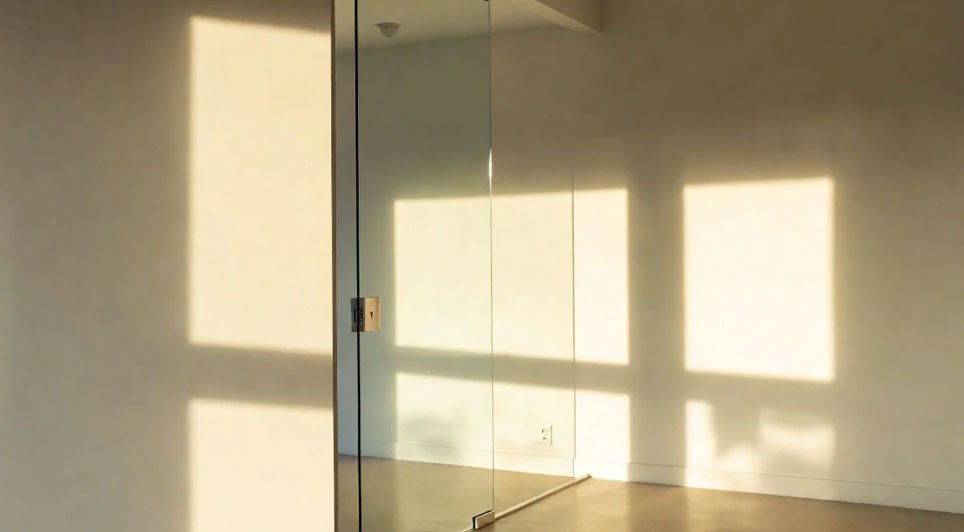
a. they are clearly defined with manifestation on the glass at two levels, 850 to1000mm and 1400 to 1600mm above the floor, contrasting visually with thebackground seen through the glass (both from inside and outside) in all lighting conditions;
b. manifestation takes the form of a logo or sign at least 150mm high (repeated if on a glazed screen), or a decorative feature such as broken lines or continuous bands, at least 50mm high; any glazed screens alongside a corridor are clearly defined with manifestation the glass at two levels, 850 to 1000mm and 1400 to 1600mm, contrasting visually with the background seen through the glass in all lighting conditions (see 2.24(b) for details of manifestation).

Further considerations for the visually impaired should be included
2.22 People with visual impairment should be in no doubt as to the location of glass entrance doors, especially when they are within a glazed screen. The choice of a different style of manifestation for the door and the glazed screen can help to differentiate between them.
Further guidelines are covered by Regulation 14 of the Workplace (Health, Safety and Welfare) Regulations 1992. The Regulation requires that every window or other transparent or translucent surface in a wall, partition, door or gate should, where necessary for reasons of health or safety, be of a safety material or be protected against breakage of the transparent or translucent material; and be appropriately marked or incorporate features to make it apparent.
Regulation 14 also says that glazing in critical locations must be marked, or incorporate appropriate design features, to make its presence apparent – the objective being to avoid breaking the noses of people who might otherwise walk into the glazing, not realising it was there.
The Regulation only expects action ‘where necessary for reasons of health or safety’. So you need to assess every window or other transparent or translucent surface in a wall, partition, or door or gate to establish whether there is a risk of anyone being hurt if people or objects come into contact with it, or if it breaks.